
Why always-on marketing is more efficient than campaign bursts.
There’s a common assumption in B2B marketing that efficiency comes from control. Short campaigns. Tight targeting. Clear start and end dates. On paper, it feels disciplined. In practice, it’s often the opposite.
Over time, I’ve seen always-on marketing outperform one-off campaign bursts on efficiency, not because brands spend more, but because they stop paying to relearn the same lessons again and again. Your buyers don’t switch on and off with your campaigns, so your marketing shouldn’t either.
To be clear: always-on doesn’t replace campaigns. It connects them.
The hidden cost of relying on one-off campaigns
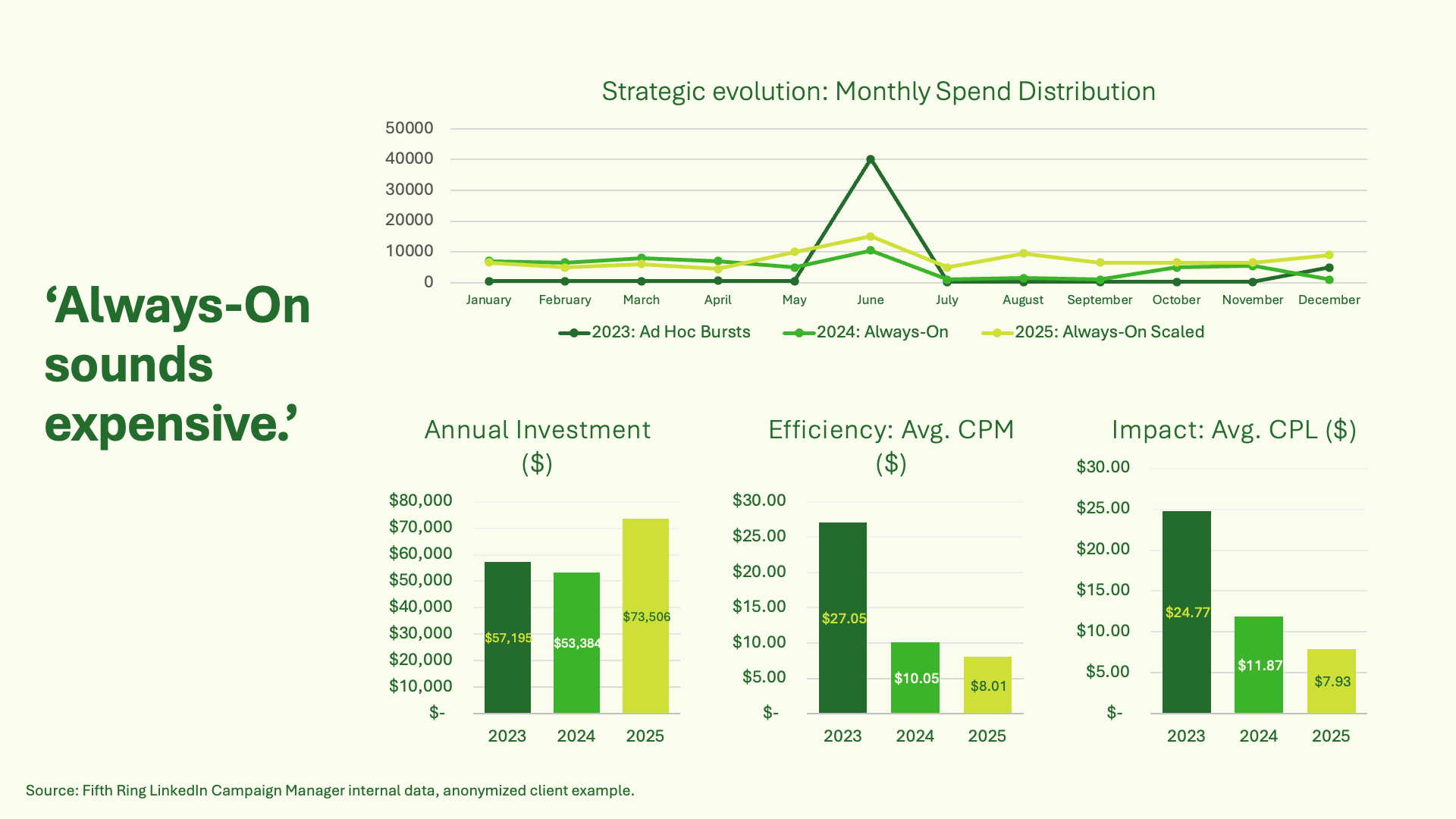
Standalone campaigns look neat in planning decks. Each has a brief, a budget, a launch date and a report at the end. What often gets overlooked is the reset. Every time a one-off campaign ends, learning slows or stops. Audiences cool. Performance data becomes stale. When the next campaign starts, teams effectively pay a “learning tax” all over again: new optimisation cycles, new signals to interpret, familiar ground to re-cover.
That reset is expensive. Not just in media spend, but in time, effort and opportunity cost. Always-on marketing removes that unnecessary reset between campaigns. When activity runs continuously, the platform’s algorithm keeps learning. Patterns start to emerge. Performance improves because the system is allowed to mature, rather than being switched off just as it becomes effective.
Efficiency doesn’t come from stopping. It comes from continuity.
Always-on is not “more campaigns”
One of the biggest concerns around always-on is resourcing. “Running four campaigns a year is already hard. How are we supposed to do this all the time?” The irony is that always-on, when designed properly, is often easier to manage than a series of disconnected, one-off campaigns. Instead of spinning up new messaging, creative and reporting frameworks every few months, teams work within a stable system: a consistent narrative,reusable creative structures and defined audiences that evolve over time.
Campaigns still exist. They just sit within a framework that allows learning to carry forward. The work shifts from restarting to refining. That’s where efficiency really starts to show.
Where ABM fits (and where it doesn’t)
Always-on marketing builds presence and learning. ABM is how you use that learning. Too often, ABM is treated as a standalone solution: upload a list, launch highly targeted activity, hope for results. Without context, it becomes precision without intelligence. When always-on activity is in place, something different happens. You start to see patterns:
ABM then becomes a precision layer, not a gamble. A simple way to see it: Always-on is the engine, ABM is the steering. Always-on builds the signals and patterns. ABM uses those signals to narrow the spotlight, shifting more budget and more tailored content towards accounts that are actually leaning in.
Research from the Ehrenberg-Bass Institute and LinkedIn’s B2B Institute suggests that at any given time, only around 5% of B2B buyers are actively in-market, which means roughly 95% are out-of-market and won’t be buying for months or years. The 95% are exactly who always-on is for: staying visible, building memory and earning trust long before a buying cycle starts. ABM then lets you act quickly on the 5% who are ready now, using clear intent signals to narrow the focus instead of guessing.
You’re no longer spreading budget across companies that were never going to buy. You’re narrowing the spotlight based on behaviour, familiarity and intent. That’s why ABM tends to become more efficient than broad targeting over time. Not because it’s inherently clever, but because it’s informed.
Same budget, smarter use
One of the most persistent myths around always-on and ABM is that they require bigger budgets. In reality, many teams don’t need more money. They need a better way to aim what they already have. When marketing relies heavily on one-off campaigns, budget is spent re-establishing awareness, retargeting pools never properly build, and learning is constantly interrupted.
With always-on, learning compounds, waste reduces, and more budget naturally flows towards accounts showing genuine interest. The total spend doesn’t have to grow. It simply follows intent instead of guesswork.
When always-on “doesn’t work”
When teams say they’ve tried always-on and it didn’t deliver, the issue is rarely the model itself. More often, it’s what sits underneath: an unclear value proposition, inconsistent messaging, weak measurement infrastructure, or misalignment between brand, demand and sales. Always-on doesn’t fix those problems. It exposes them. Once the foundations are clear, always-on becomes not only more effective, but more predictable. Remember to fix the why before scaling the how.
The shift B2B teams are starting to make
The most successful B2B teams I see today aren’t asking how to run more one-off campaigns. They’re asking how to build systems that allow campaigns to work harder, learn faster and connect more meaningfully over time. Always-on marketing provides that foundation. ABM adds focus when intent appears. Brand and thought leadership reduce friction long before sales conversations start.
Efficiency doesn’t come from stopping and starting.
It comes from letting the system learn.