
Lead theater is a drama that's becoming a crisis in B2B marketing
Most B2B marketing stops too early. Optimizing for leads creates the illusion of progress while real growth is won or lost further downstream.
Many B2B organizations don’t have a lead problem. They have a measurement problem.
Leads are flowing. Dashboards are full. MQL targets are being hit. Yet pipelines feel slow, deals drag on, and forecast confidence is fragile. That gap between activity and outcome is not accidental. It’s the result of lead theater: metrics that look impressive but explain very little about whether revenue will actually materialize.
This isn’t about denying the value of demand. Without leads, there is no pipeline. But when loosely defined leads or MQLs become the primary measure of marketing success, they stop being useful and start becoming misleading.
Lead-centric models were built for a simpler time. Shorter buying cycles. Fewer stakeholders. Cleaner marketing to sales handovers. Today, buying decisions involve large, cross-functional groups, internal disagreement, and long periods of hesitation. Deals rarely fail outright. They stall.
Lead metrics are blind to this reality.
They tell you who showed interest. They tell you nothing about where confidence drops, where consensus breaks down, or where momentum leaks away once a deal is live. So marketing reports success, sales experiences friction, and leadership is left trying to reconcile two versions of the truth.
This is where lead theater becomes expensive.
The death of the MQL.
When marketing is optimized around volume, effort is rewarded upstream and withdrawn downstream. Marketing steps out of the pipeline just as uncertainty increases, leaving sales to manage complexity alone. In a time when everyone could be found in their office, this might have been manageable through frequent sales calls and visits. But today the rules have changed. The result is familiar: slower deals, weaker forecasts, and growing scepticism about marketing’s commercial value.
This isn’t just anecdotal. Forrester’s own research has shown that in traditional, MQL-led waterfall models, the typical conversion rate from initial inquiry through to closed revenue is under one per cent. In other words, the vast majority of what is counted, celebrated, and reported at the top of the funnel never becomes revenue.
The reason is structural. Buying decisions are no longer made by individuals; they are made by buying groups. Yet lead-based models continue to treat qualification as an individual scoring exercise, often built on thresholds that have little grounding in real buying intent.
The problem isn’t that leads exist.
It’s that we stop there.
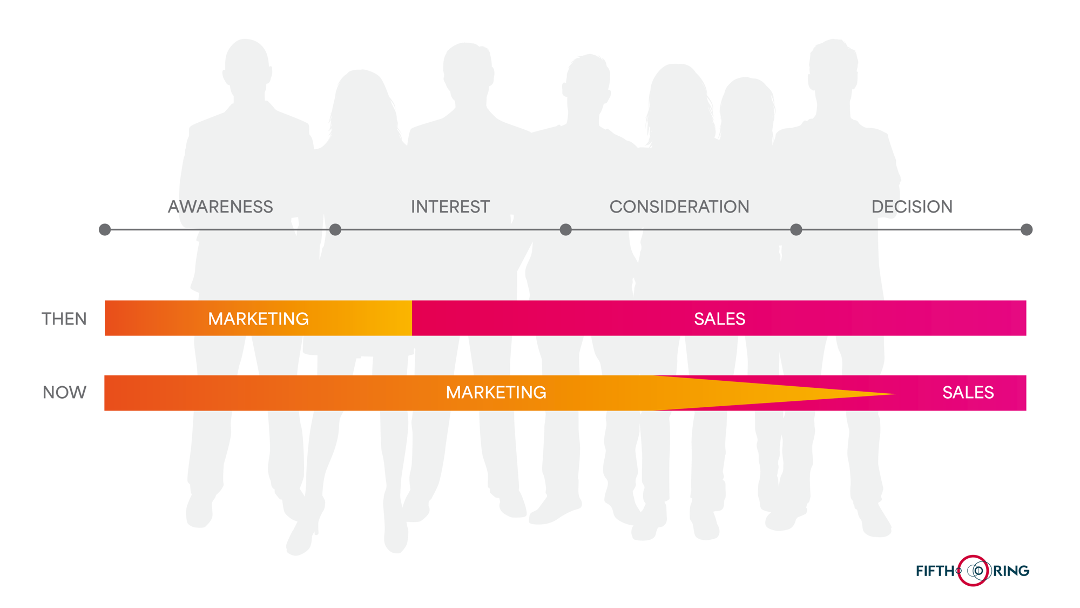
What changed when we stopped optimising for leads.
Through our Predictive Revenue approach, we’ve long-since moved away from judging marketing solely by how much it generates, and towards how it influences what happens inside the pipeline and beyond. That means aligning marketing, sales and finance around a shared view of deal progression, not just deal entry.
In one large, enterprise organization we’re working with, the objective wasn’t more leads. It was improving the conversion of sales-qualified opportunities into closed revenue. Rather than launching more campaigns, the focus shifted to understanding where deals were slowing down, what information buyers needed at decision stages, and how marketing could support sales conversations already in progress.
The result wasn’t louder marketing. It was narrower, more deliberate intervention: tools that helped sales justify value, messaging that reduced uncertainty, and visibility that allowed both teams to see which deals were moving and which w ere stalling. The goal was simple: move conversion from one-in-five deals closing to one-in-four. Not by generating more demand, but by improving momentum where it mattered.
That work is still ongoing. But the direction is clear. When marketing stays involved beyond handover, waste reduces, alignment improves, and leadership gets a far more credible view of growth.
From theater to traction.
Moving beyond lead theater doesn’t mean abandoning leads. It means refusing to pretend that leads are the outcome.
Real growth is determined further downstream, where buying groups hesitate, internal justification begins, and decisions either regain momentum or drift. These are moments where marketing still has a role to play: reinforcing value, reducing perceived risk, and supporting progression.
Leads may start the conversation.
But momentum decides how it ends.
Until marketing is engaged with sales working within the pipeline, and until marketing is designed and measured with that in mind, businesses will continue to look busy while revenue performance lags underneath.